 Home Home
Season's Greetings!
The Economic Crisis:
A Dog's Perspective
About Those Hounds...
Our Hounds
Adopting a Friend
Adoption Application
Rescue of the Month
Special Rescues
The Bagel Shoppe
The Old Age Page
Black Listed Beauties
Katrina's Other Victims
Getting Involved - Volunteering
The Ugly Truth
Success Stories
Wishlist
The Homewoods Herald
Houndware
Memorials
Muchas Gracias
Contact
 Pryor's Planet
Dorchester Co. Humane Society
Ritchie Co. Humane Society
Humane Society of North Central West Virginia
Whimsical Animal Rescue
|
|


 Everyone knows that the “dog days of summer” occur during the hottest and muggiest part of the season. Webster defines “dog days” as... Everyone knows that the “dog days of summer” occur during the hottest and muggiest part of the season. Webster defines “dog days” as...
1 : the period between early July and early September when the hot sultry weather of summer usually occurs in the northern hemisphere
2 : a period of stagnation or inactivity
But where does the term come from? Why do we call the hot, sultry days of summer “dog days?”
In ancient times, when the night sky was unobscured by artificial lights and smog, different groups of peoples in different parts of the world drew images in the sky by “connecting the dots” of stars. The images drawn were dependent upon the culture: The Chinese saw different images than the Native Americans, who saw different pictures than the Europeans. These star pictures are now called constellations, and the constellations that are now mapped out in the sky come from our European ancestors.
They saw images of bears, (Ursa Major and Ursa Minor), twins, (Gemini), a bull, (Taurus), and others, including dogs, (Canis Major and Canis Minor).
The brightest of the stars in Canis Major (the big dog) is Sirius, which also happens to be the brightest star in the night sky. In fact, it is so bright that the ancient Romans thought that the earth received heat from it. Look for it in the southern sky (viewed from northern latitudes) during January.
In the summer, however, Sirius, the “dog star,” rises and sets with the sun. During late July Sirius is in conjunction with the sun, and the ancients believed that its heat added to the heat of the sun, creating a stretch of hot and sultry weather. They named this period of time, from 20 days before the conjunction to 20 days after, “dog days” after the dog star.
The conjunction of Sirius with the sun varies somewhat with latitude. And the “precession of the equinoxes” (a gradual drifting of the constellations over time) means that the constellations today are not in exactly the same place in the sky as they were in ancient Rome. Today, dog days occur during the period between July 3 and August 11. Although it is certainly the warmest period of the summer, the heat is not due to the added radiation from a far-away star, regardless of its brightness. No, the heat of summer is a direct result of the earth's tilt.
What You Should Know about Flea and Tick Products
 Protecting your pet from fleas and ticks is an important part of caring for your pet responsibly. Although there are many brands of over-the-counter flea and tick products available at supermarkets and pet supply stores, it is critical to read their labels, and consult with your veterinarian, before using them on your companion. These products may contain ingredients that could harm pets and children. Protecting your pet from fleas and ticks is an important part of caring for your pet responsibly. Although there are many brands of over-the-counter flea and tick products available at supermarkets and pet supply stores, it is critical to read their labels, and consult with your veterinarian, before using them on your companion. These products may contain ingredients that could harm pets and children.
In November 2000, the Natural Resources Defense Council (NRDC) released a report called Poisons on Pets: Health Hazards from Flea and Tick Products. The report demonstrated a link between chemicals commonly used in flea and tick products and serious health problems.
The Chemicals
The ingredients to be wary of are organophosphate insecticides (OPs) and carbamates, both of which are found in various flea and tick products. A product contains an OP if the ingredient list contains chlorpyrifos, dichlorvos, phosmet, naled, tetrachlorvinphos, diazinon, or malathion. If the ingredient list includes carbaryl or propoxur, the product contains a carbamate. According to the NRDC, the potential dangers posed by these products are greatest for children and pets. There is reason to be concerned about long-term, cumulative exposures as well as combined exposures from the use of other products containing OPs and carbamates.
 The Products The Products
The NRDC's report lists flea- and tick-control products marketed under the following major brand names that have been found to contain OPs: Alco, Americare, Beaphar, Double Duty, Ford's Freedom Five, Happy Jack, Hartz, Hopkins, Kill-Ko, Protection, Rabon, Riverdale, Sergeant's, Unicorn, Vet-Kem, Victory, and Zema. To protect their pets and children, consumers should consult with a veterinarian before purchasing over-the-counter (OTC) products.
The Effects
According to the NRDC, there are studies that show OPs and carbamates can harm the nervous system. Children can be especially vulnerable because their nervous systems are still developing. For pets, the data is limited, but according to NRDC, many companion animals appear to have been injured or killed through exposure to pet products containing OPs. Cats are particularly vulnerable, since they often lack enzymes for metabolizing or detoxifying OPs and can ingest OPs by licking their fur.
What about the EPA?
Each year, millions of Americans purchase over-the-counter flea and tick products believing that they couldn't be sold unless they were proven safe. But the Environmental Protection Agency (EPA) did not begin to review pet products for safety until 1996. There is a substantial backlog of products waiting to be tested, so many pet products containing potentially harmful pesticides still make their way onto store shelves.
 Last year, after reaching an agreement with manufacturers, the EPA announced that the OP chlorpyrifos—also known as Dursban—would be on a fast track for a phase-out. A second OP, diazinon, is also on the way out. An agreement between the EPA and manufacturers set the phase out at December 2002 for indoor-use products (including flea and tick products) and December 2003 for all lawn, garden, and turf products. Last year, after reaching an agreement with manufacturers, the EPA announced that the OP chlorpyrifos—also known as Dursban—would be on a fast track for a phase-out. A second OP, diazinon, is also on the way out. An agreement between the EPA and manufacturers set the phase out at December 2002 for indoor-use products (including flea and tick products) and December 2003 for all lawn, garden, and turf products.
Reducing the Risks
It is recommended that the following precautions be taken to reduce the risks to pets and humans during the flea season:
- Use alternatives to pesticides to control fleas and ticks: Comb your pet regularly with a flea comb, vacuum frequently and dispose of the bags immediately after use, mow areas of the lawn where your dog spends time, wash pet bedding weekly, and wash your pet with a pesticide-free pet shampoo. In addition, to protect cats from fleas and ticks, as well as a host of other outdoor hazards, cats should be kept indoors at all times.
- Always consult a veterinarian before buying or using any flea or tick control product on your pet.
- Never use flea and tick products designed for dogs on your cat, or vice versa.
- Remember never to apply pesticides to very young, elderly, pregnant, or sick animals unless directed to do so by a veterinarian.
- Always read the ingredients, instructions, and warnings on the package thoroughly.
- Avoid OP-based products by looking for any of these active ingredients: chlorpyrifos, dichlorvos, phosmet, naled, tetrachlorvinphos, diazinon and malathion. Avoid products with carbamates by looking for the chemical names carbaryl and propoxur on the label.
- Consider using a product with insect-growth regulators (IGRs), which are not pesticides. These will prevent the next generation of fleas but will not kill insects already on your pet. Common and effective IGR products include those made with lufenuron (found in Program® and Sentinel® and available by prescription), methoprene (in Precor®), and pyriproxyfen (in Nylar® and EcoKyl®).
- You might want to consider several relatively new topical products, available through veterinarians, that are insecticides designed to have fewer toxic effects on the nervous systems of mammals: imidacloprid (found in Advantage®), fipronil (in Frontline® or Top Spot®), and selamectin (in Revolution™).
If you suspect your pet may have suffered negative health effects as a result of a flea product containing OPs or carbamates, consult with your veterinarian immediately. If you think a child has ingested a pesticide, call your local poison control center. Be sure to report all such incidents to the EPA's National Pesticide Telecommunications Network at 800-858-7378.
The HSUS would also like to keep track of these cases.* Please send your contact information, the product name, a brief description of the health problem, and a brief summary of your veterinarian's findings to The HSUS.
 Summer Care Tips for You and Your Pets Summer Care Tips for You and Your Pets
Summer is a time for both you and your pet to enjoy the sunshine and outdoors, but along with the fun, the season also offers up situations that can endanger your pet. By taking precautions, you can decrease the chance that disaster will happen. HR offers these tips for pet owners to keep their furry friends safe this summer:
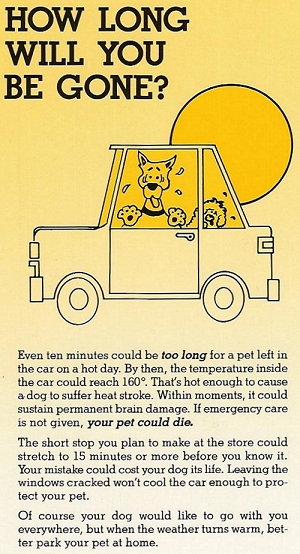
- In nice weather you may be tempted to take your pet with you in the car while you travel or do errands. But during warm weather, the inside of your car can reach 120° in a matter of minutes, even if you're parked in the shade. This can mean real trouble for your companion animals left in the car. Dogs and cats can't perspire and can only dispel heat by panting and through the pads of their feet. Pets who are left in hot cars even briefly can suffer from heat exhaustion, heat stroke, brain damage, and can even die. Don't think that just because you'll be gone "just a minute" that your pet will be safe while you're gone; even an air conditioned car with the motor off isn't healthy for your pet. To avoid any chance that your pet will succumb to the heat of a car this summer, be sure to play it safe by leaving your pet cool and refreshed at home while you're on the road. And if you do happen to see a pet in a car alone during the hot summer months, alert the management of the store where the car is parked. If the owner does not return promptly, call local animal control or the police department immediately.
- Want to help educate others about the dangers of leaving pets in hot cars? During the summer months (May through September) The HSUS has educational posters available for purchase ($3 for 10, $5 for 25) that store managers can post inside their windows to remind shoppers that "Leaving Your Pet in a Parked Car Can be a Deadly Mistake". In addition, 4" x 9" two-sided flyers are also available (50 for $3.00). To order please send a check, your mailing address and the number of posters or flyers that you would like to receive to the following address: HSUS/Hot Cars, 2100 L Street, NW, Washington, DC 20037. You can also receive a free sample flyer by sending a self-addressed, stamped envelope to the above address.
- It is very dangerous, and in some states illegal, to drive with a dog in the back of a pick-up truck. Not only can flying debris cause serious injury, but a dog may be unintentionally thrown into traffic if the driver suddenly hits the brakes, swerves, or is hit by another car. Dogs should ride either in the cab (in a crate or wearing a seat belt harness designed for dogs) or in a secured crate in the bed of the truck.
- Summer is often a time when people fertilize their lawns and work in their gardens. But beware: Plant food, fertilizer, and insecticides can be fatal if your pet ingests them. In addition, more than 700 plants can produce physiologically active or toxic substances in sufficient amounts to cause harmful effects in animals.
- With people and dogs spending more time outside, dog bites are likely to increase in the summer months. Spaying or neutering your dog reduces the likelihood that he will bite and provides many other health benefits.
- Make sure your pet is always wearing a collar and identification tag. If you are separated from your pet, an ID tag may very well be his or her ticket home.
- Check with your veterinarian to see if your pets should be taking heartworm prevention medication. Heartworm disease, which is transmitted by mosquitoes, can be fatal in both dogs and cats.
- Pets and pools can equal disaster. Prevent free access to pools and always supervise a pet in a pool.
- Provide plenty of water and shade for your pets while they're enjoying the great outdoors so they can stay cool.
- If you plan on traveling with your pet during the summer, take the time to prepare for your furry friends in advance. Many airlines have summer pet embargoes, and most trains and ships do not allow pets other than service animals.
- Pets need exercise even when it is hot, but extra care needs to be taken with older dogs, short-nosed dogs, and those with thick coats. On very hot days, limit exercise to early morning or evening hours. Keep in mind that asphalt gets very hot and can burn your pet's paws.
- Another summertime threat is fleas and ticks. Use only flea and tick treatments recommended by your veterinarian. Some over-the-counter flea and tick products can be toxic, even when used according to instructions.
- Pets can get sunburned too, and your pet may require sunscreen on his or her nose and ear tips. Pets with light-colored noses or light-colored fur on their ears are particularly vulnerable to sunburn and skin cancer.
- Don't take your pets to crowded summer events such as concerts or fairs. The loud noises and crowds, combined with the heat, can be stressful and dangerous for pets. For your pet's well being, leave her at home. Be especially aware of these threats during holidays, such as the Fourth of July.
- In summer heat your pet can suffer from heat exhaustion and heat stroke. These conditions are very serious and could cause your pet to die. You should be aware of the signs of heat stress, which could include heavy panting, glazed eyes, a rapid pulse, unsteadiness, a staggering gait, vomiting, or a deep red or purple tongue. If your pet does become overheated, you need to immediately lower his body temperature. Move your pet into the shade and apply cool (not cold) water over his body to gradually lower his core body temperature. Apply cold towels or ice packs to your pet's head, neck, and chest only. Let your pet drink small amounts of water or lick ice cubes. Most importantly, get him to a veterinarian immediately.
 On July 4, 1776, we claimed our independence from Britain and Democracy was born. Every day thousands leave their homeland to come to the "land of the free and the home of the brave" so they can begin their American Dream. On July 4, 1776, we claimed our independence from Britain and Democracy was born. Every day thousands leave their homeland to come to the "land of the free and the home of the brave" so they can begin their American Dream.
Won't you liberate a rescue dog on America's birthday and give it a loving, forever home?
KEEPING YOUR PET SAFE ON JULY 4TH
Returning home from a holiday celebration, Sharon Moore and her family discovered feces on their living room floor. The sliding glass door to their backyard was open, and a hole had been dug under their fence.
The Moores were gone for only four hours, but D.O.G., their two-year-old, aptly-named white German Shepherd, was gone. Left on her own to face the tumult of fireworks and loud celebrations, she escaped, apparently to seek the familiar—her family, even if she had no idea where to look.
"From what we can tell, when D.O.G. heard the fireworks she freaked out and pooped on the floor inside—for the first time ever—then she opened the sliding glass door with her paw, and dug a hole outside our fence.... She went searching for us," says Sharon Moore of Maitland, Florida.
The Moores' search for D.O.G. ended when she was found dead alongside a road where she was often walked.
Moore believes that D.O.G., who wasn't normally scared of thunder or other loud noises, panicked from the cumulative effects of the fireworks, the excited voices outside, and being left alone inside the house.
 The Moores' tragic loss isn't unique. Pets across the nation often become frightened and frantic by the noise and commotion of Independence Day. In fact, animal shelters across the country are accustomed to receiving "July 4th" dogs—dogs who run off during fireworks celebrations and are rescued by animal control officers or Good Samaritans who take them to the safety of the local shelter. The Moores' tragic loss isn't unique. Pets across the nation often become frightened and frantic by the noise and commotion of Independence Day. In fact, animal shelters across the country are accustomed to receiving "July 4th" dogs—dogs who run off during fireworks celebrations and are rescued by animal control officers or Good Samaritans who take them to the safety of the local shelter.
Fortunately, preventing pet problems on Independence Day is possible by simply planning ahead and taking some basic precautions.
"With a little bit of planning and forethought, you can enjoy the excitement of the Fourth of July and know that your animal companion is safe, sound, and enjoying a little peace and quiet," says Nancy Peterson, an issues specialist with The HSUS.
To protect your pet on the Fourth of July, take these precautions:
- Resist the urge to take your pet to fireworks displays.
- Do not leave your pet in the car. With only hot air to breathe inside a car, your pet can suffer serious health effects, even death, in a few short minutes. Partially opened windows do not provide sufficient air, but do provide an opportunity for your pet to be stolen.
- Keep your pets indoors at home in a sheltered, quiet area. Some animals can become destructive when frightened, so be sure that you've removed any items that your pet could destroy or that would be harmful to your pet if chewed. Leave a television or radio playing at normal volume to keep him company while you're attending Fourth of July picnics, parades, and other celebrations.
- If you know that your pet is seriously distressed by loud noises like thunder, consult with your veterinarian before July 4th for ways to help alleviate the fear and anxiety he or she will experience during fireworks displays.
- Never leave pets outside unattended, even in a fenced yard or on a chain. In their fear, pets who normally wouldn't leave the yard may escape and become lost, or become entangled in their chain, risking injury or death.
- Make sure your pets are wearing identification tags so that if they do become lost, they can be returned promptly. Animals found running at-large should be taken to the local animal shelter, where they will have the best chance of being reunited with their owners.
If you follow these simple precautions, you and your pet can have a safe and happy Fourth of July.
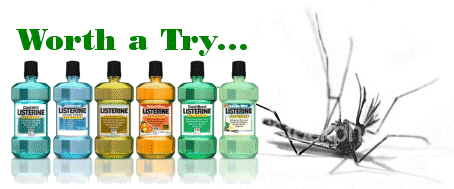 I was at a deck party awhile back, and the bugs were having a ball biting everyone. A man at the party sprayed the lawn and deck floor with Listerine, and the little demons disappeared. The next year I filled a 4-ounce spray bottle and used it around my seat whenever I saw mosquitoes. And voila! That worked as well.. It worked at a picnic where we sprayed the area around the food table, the children's swing area, and the standing water nearby. During the summer, I don't leave home without it. Pass it on. I was at a deck party awhile back, and the bugs were having a ball biting everyone. A man at the party sprayed the lawn and deck floor with Listerine, and the little demons disappeared. The next year I filled a 4-ounce spray bottle and used it around my seat whenever I saw mosquitoes. And voila! That worked as well.. It worked at a picnic where we sprayed the area around the food table, the children's swing area, and the standing water nearby. During the summer, I don't leave home without it. Pass it on.
OUR FRIENDS' COMMENTS: I tried this on my deck and around all of my doors. It works - in fact, it killed them instantly. I bought my bottle from Target and it cost me $1.89. It really doesn't take much, and it is a big bottle, too, so it is not as expensive to use as the can of Bug-spray you buy that doesn't last 30 minutes. So, try this, please. It will last a couple of days. Don't spray directly on a wood door (like your front door), but spray around the frame. Spray around the window frames, and even inside the dog house.
|